
Opening a physical therapy practice is a major milestone. But before you can bill a single insurer, you need to complete physical therapy credentialing. This is a process that even well-prepared new owners trip up.
Credentialing is how insurance payers verify your qualifications and approve you to participate in their network. You cannot submit claims or receive reimbursement without it. This guide covers the physical therapy billing services essentials: federal and state requirements, commercial payer rules, common mistakes, and how to keep your timeline on track.
What Is Physical Therapy Credentialing?
Physical therapy credentialing is the process insurers use to verify a provider’s license. They also review education, malpractice history, and practice details before approving them for network participation. It must be completed separately with Medicare, Medicaid, and each commercial payer you plan to accept.
It is not a one-time task. Most payers require re-credentialing every two to three years. For new owners, it is the most common administrative reason reimbursements are delayed at launch because applications are started too late or submitted with errors.
Key Physical Therapy Credentialing Requirements
Physical therapy credentialing requirements differ by payer, but almost all applications require a basic set of documents. Having these handy even before you submit can cut weeks off your processing time.
- Active license for physical therapy in the state
- Individual NPI (Type 1) and Group NPI (Type 2)
- Completed and attested CAQH ProView profile
- Proof of professional liability (malpractice) insurance
- Updated CV without unexplained gaps in employment
- Verification of PT degree and specialty certificates
- Practice location and facility documents
- Enrollment in Medicare and/or Medicaid
Federal and state requirements
Medicare enrollment is done through the Provider Enrollment and Ownership System (PECOS). You have to register both the individual therapist and the practice separately. Usually, rejections are caused by discrepancies between the two.
Medicaid is managed at the state level. Their guidelines, portals, and processing times vary greatly by state. For example, some states have an efficient online enrollment system while others rely on paper forms and have very long waiting times. Find out your state’s procedure early and consider it a different workstream from Medicare.
Tip: One thing to note is that you should mark your calendar for renewal dates of the state license and malpractice policy. Both items are critical; even a short lapse can stop your credentialing application and can get you removed from payer panels you already belong to.
Commercial payer requirements
Each private insurer has its own credentialing process. They mostly use CAQH ProView as a common data source but each payer still does its own verification and might ask for extra documents.
Some payers use online portals and others still rely on paper forms or fax. Before submitting, always confirm whether a payer’s panel is open in your area. Some networks are closed to new providers regardless of qualifications. This just wastes many weeks after submission.
Timeline and common delays
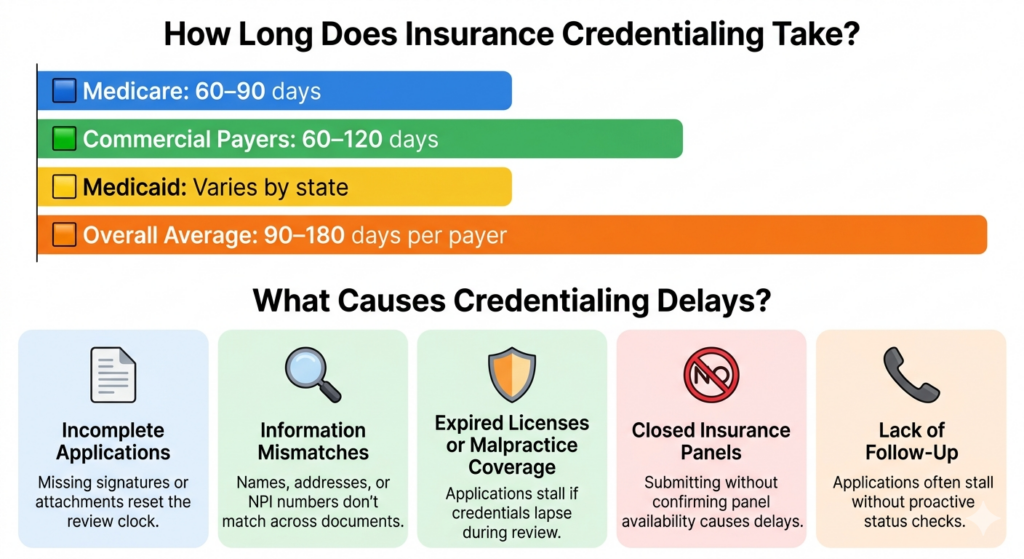
Expect 90 to 180 days per payer. Medicare typically takes 60 to 90 days. Commercial payers range from 60 to 120 days. Medicaid varies by state.
The most common delay triggers:
- Incomplete applications or missing signature attachments can reset the clock
- Information mismatches, such as names, addresses, or NPI numbers that differ across documents
- Malpractice coverage or licensure that lapses mid-application
- Closed panels that are not confirmed before submitting
- Lack of follow-up because applications do not move without proactive check-ins
Credentialing Vs Enrollment Vs Contracting
These three terms are often confused. Each refers to a distinct step, and completing them out of sequence causes billing problems.
| Credentialing | Enrollment | Contracting |
| Verifies provider qualifications, their background and license. | Registers the provider with a payer so claims can be processed. | Establishes reimbursement rates and terms between provider and payer. |
| Must be completed first. | Required before billing government programs. | Negotiable with most commercial payers. |
All three must be completed before you can receive reimbursement. Credentialing verifies who you are. Enrollment registers you with the payer. Contracting determines what you get paid.
Step-By-Step Credentialing Process For New Owners
Breaking credentialing into phases makes it manageable and reduces the risk of errors that cause delays.
Preparing documentation
Build a credentialing folder with every required document verified and consistent before you submit anything. Your NPI address and tax ID must match exactly across all forms. A smallest variation can trigger a flag.
Start by including your state license, both NPI confirmation letters, and a fully attested profile. Keep a malpractice certificate with retroactive coverage dates along with copies of your degree.
Submitting applications
Start with Medicare PECOS and state Medicaid first, government programs take the longest. Then prioritize the commercial payers that cover the highest share of your local patient population. Run both applications in parallel and do not wait for one approval before submitting the next.
Confirm receipt with each payer within five business days of submission. Track every application in a spreadsheet. Track submission date, portal login, contact name, and next follow-up date. Follow up every two to three weeks.
Common Credentialing Challenges And Pitfalls
Even thorough applications run into problems. Watch for these:
- CAQH attestation expired: Must be re-attested every 120 days, or it delays every payer that uses it.
- Retroactive malpractice coverage missing: Most payers require tail coverage. A forward-only policy will result in denial.
- Billing before written approval: A submitted application is not an approved one. Do not schedule patients as in-network until you have written confirmation.
- Applying to closed panels: Always call the payer’s provider relations line to confirm the panel is open first.
Credentialing errors feed directly into claim denials down the line. Strong denial management in medical billing starts with getting credentialing right the first time.
How Park Medical Billing Helps New Owners With Credentialing
Physical therapy credentialing is detail-heavy and unforgiving of mistakes. For new owners juggling hiring, compliance, and patient scheduling, it is easy to slip up with costly consequences. Our medical billing services take credentialing off your plate entirely.
The team handles documentation preparation, CAQH profile completion, Medicare and Medicaid enrollment, and commercial payer applications, all of which are tracked through to written approval. Clients see faster timelines and fewer denials as a direct result.
Credentialing is also the foundation of your broader revenue cycle management strategy. Getting approved with the right payers, on time, with accurate documentation means cleaner claims and faster payments from day one.
Final Thoughts
Physical therapy credentialing is not the most exciting part of opening a practice. But it is one of the most consequential. Get it right and you are positioned for clean claims, steady reimbursement, and a strong revenue foundation from day one. Get it wrong, and you may spend your first months managing denials, chasing approvals, and absorbing avoidable cash flow gaps.
The key is to start early and stay organized. You must understand that each payer has its own rules whether you manage credentialing in-house or work with a billing partner, the practices that succeed treat credentialing as a strategic priority.
If you would like expert support navigating this process, Park Medical Billing’s credentialing and physical therapy billing services team is ready to help you get credentialed faster with reduced errors to protect your revenue from the start.